
From Avatar's floating peaks to the Terracotta Army — one iconic sight from each of our seven destinations.

The Terracotta Warriors are a life-size clay army buried to guard the tomb of China's first emperor, Qin Shi Huang. Each figure has a different face, and the site near Xi'an is one of the greatest archaeological discoveries of the 20th century.

Zhangjiajie National Forest Park is the heart of Wulingyuan, a UNESCO World Heritage Site known for its thousands of sandstone pillars rising through mist. Walk Golden Whip Stream, ride the Bailong Elevator, and see the peaks that inspired the floating mountains in Avatar.

The Zhangjiajie Grand Canyon Glass Bridge is one of the longest and highest glass-bottomed bridges in the world, stretching 430 metres across the canyon at a height of about 300 metres. Walking across its transparent deck gives you a clear view straight down to the gorge below.
 Zhangjiajie · Hunan
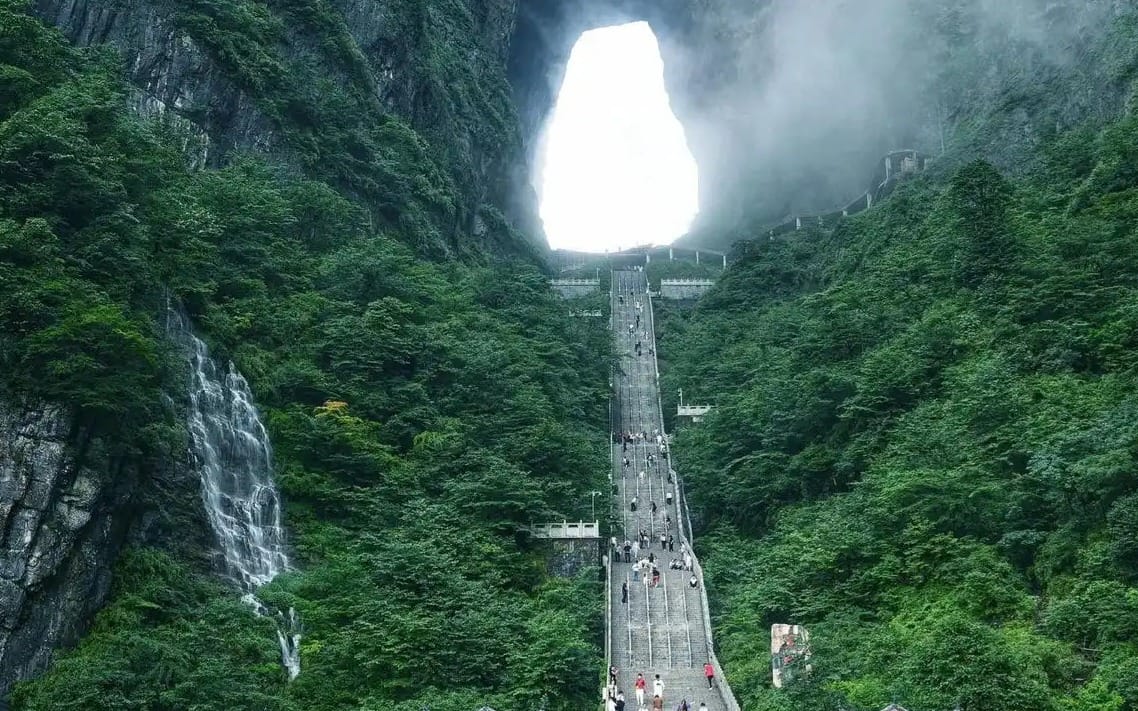
Tianmen Mountain National Forest Park sits just outside Zhangjiajie city, reached by one of the world's longest cable car rides. At the top, cliff-edge walkways and the 999-step stairway to Heaven's Gate lead through forests and cloud. Allow a full day; the cableway, shuttle buses and glass walkways are the main draws.

St. Sophia Cathedral is a landmark in Harbin, known for its distinctive Russian Orthodox architecture. The church now serves as an art gallery, showcasing the city's history and cultural heritage.

Yellow Dragon Cave is one of the largest caves in Asia, with a maze of chambers, underground streams and thousands of stalactites and stalagmites. Lit paths run through the main sections, so you can walk it in about two hours. It makes an easy half-day trip from Wulingyuan.

A relaxed, easy valley close to Chengdu — autumn colours and red-leaf forests, with skiing in winter and spring. Friendly for every kind of traveller.

The king of water scenery — a Y-shaped valley of three gullies with Five-Flower Lake, Pearl Shoal Falls, Nuorilang Falls, Long Lake and Five-Colour Pond. Autumn colours peak in September and October, and shuttle buses make it easy.

The "Queen of Sichuan Mountains" — Shuangqiao Valley is an easy, beginner-friendly route, while Changping Valley suits hikers. Snow peaks, meadows and streams, and the ideal entry point to western Sichuan.

A highland pearl on the Sichuan–Yunnan border — pig-trough boats, Lige Peninsula and the Walking Marriage Bridge, with dreamy lake scenery. It is far from Lijiang, so give it its own day.

The sacred Naxi snow mountain — the big cable car climbs to the 4,680 m glacier platform. Cable-car tickets must be booked in advance; bring oxygen and warm layers, and do not miss Blue Moon Valley below.

A laid-back old town with Renmin Road and Foreigner Street at its heart — free to enter, and at its most atmospheric after dark.

The viewpoint for the first great bend of the Li River — a sunrise favourite with wide, open views, made for photographers.

The very best of the Li River — the 20-yuan banknote view, Yellow Cloth Shoal and Nine Horse Fresco Hill are all here. Choose a 4-hour cruise from Mopanshan or a 1-hour bamboo raft at Xingping.

The symbol of Guilin — the hill that looks like an elephant drinking from the river. Free to visit, best in the evening, and the classic photo is from Gate 3.

A free museum of Ba-Yu, Three Gorges and wartime relics — closed Mondays. Opposite it, the Great Hall of the People looks like a mini Temple of Heaven; the two face each other and are easy to do together.

The viral sight of a metro train running straight through a residential building. The viewing platform is free — and it pairs well with Fotuguan and Eling Second Factory nearby.

A stilt-house complex clinging to the hillside — a real-life Spirited Away. It only really shines after dark, and the best photos are from the Grand Theatre, Qiansimen Bridge or Jiangbeizui.

The imperial garden of the song "Let Us Row the Oars" — a white dagoba, Qionghua Island and quiet courtyards that make for relaxed, old-style photos.

The easiest Great Wall section to reach from Beijing — and the classic "He who has not reached the Great Wall is not a true man" spot. Or choose Mutianyu for fewer crowds and better views.

The imperial palace of the Ming and Qing dynasties, behind its red walls and golden roofs. Closed on Mondays — book 7 days ahead, enter through the Meridian Gate and exit at the Gate of Divine Prowess.

A Tang-dynasty themed pedestrian street that glows after dark — free to enter, with lanterns, street performances and costumed performers beside the Giant Wild Goose Pagoda.

Two landmark towers at the very centre of Xi'an. See them glow after dark, snap a free photo from Kaiyuan Mall's 5th floor, and buy a combo ticket if you want to go up.

China's best-preserved ancient city wall — rent a bike at dusk, watch the sunset from Yongning Gate (South Gate) and see the walls glow after dark.

Rising 109.9 metres in Zhangjiajie's Yongding District, the Seventy-Two Wonders Tower is the world's tallest stilt-house-shaped building, a Guinness World Records-certified landmark inspired by Tujia and Miao architecture, with 18 original-style Xiangxi stilt houses hung along its sides. Its vast central arch frames distant Tianmen Cave in a "two caves facing each other" effect, while inside, three themed zones—Sky Palace Tower, Fireworks Old Street and Seventy-Two Wonders Village—host immersive performances, guochao photo streets, intangible-heritage craft workshops, Xiangxi street food and a lively bar street. Easily reached by taxi or bus within the city, it stands as Zhangjiajie's cultural landmark and night-economy hub.